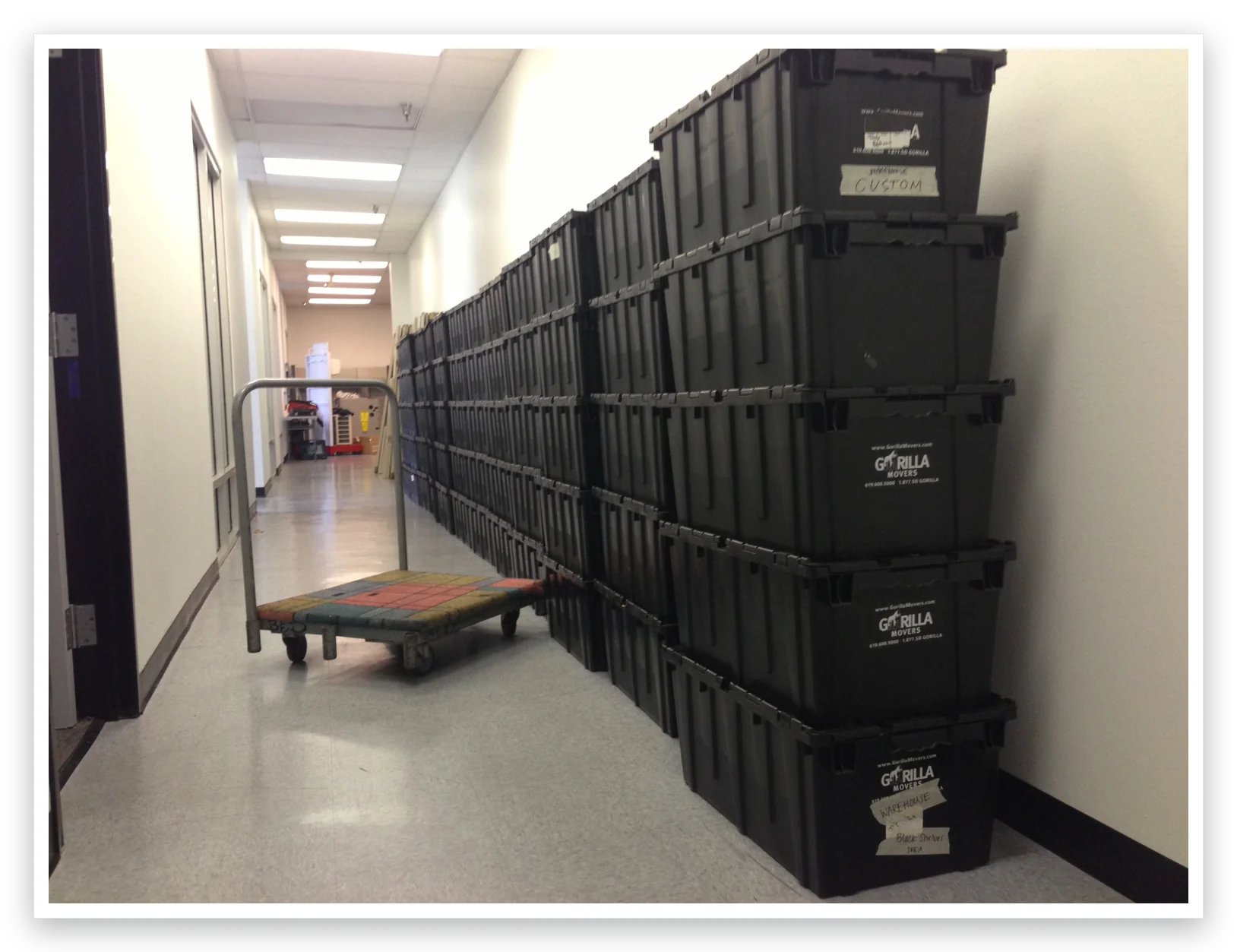
Local moves stay within roughly 100 miles, price hourly, and finish in a day. Long-distance moves cross the 100-mile line or state borders, price on weight and mileage, run under federal USDOT regulation, and can take days to deliver. Commercial moves relocate businesses on custom quotes, after-hours schedules, and downtime math. Identify your category first, it determines the mover you need, the price structure you'll see, and the paperwork that protects you.
The three categories, defined by a mover
Every move we've run in 18 years fits one of three buckets, and the bucket decides almost everything downstream. A local move covers a short distance, inside the same metro, generally under 100 miles, and wraps in a single day. A long-distance move goes beyond that, and the moment it crosses a state line it becomes an interstate move governed by federal rules regardless of mileage. A commercial move relocates a business, and distance matters less than downtime.
Why care about definitions? Because hiring the wrong category of mover is the root of most moving horror stories: an hourly local crew improvising an interstate haul, or a household mover discovering mid-job that server racks aren't sofas.
How each one is priced
The billing models are genuinely different, and knowing them keeps quotes comparable. Local moves bill hourly, crew size, truck, and time, with access factors like stairs and long carries showing up as time on the clock. Our local rates are quoted up front with fuel itemized as its own line.
Long-distance moves price on the weight of your shipment and the miles it travels, with packing, storage, and bulky-item handling layered on top. Commercial moves get a custom quote built from a site survey, because a ten-desk office and a ten-room house are nothing alike once IT, inventory, and after-hours labor enter the math.
| Local | Long-distance | Commercial | |
|---|---|---|---|
| Distance | Under ~100 miles, same metro | 100+ miles or across state lines | Any, downtime matters more |
| Pricing | Hourly rate | Weight × mileage | Custom quote from site survey |
| Timeline | One day | Days to weeks, delivery window | Nights and weekends, phased |
| Regulation | State (BHGS / CAL-T in California) | Federal (USDOT / FMCSA) | State or federal, plus building rules |
| Hardest part | Access: parking, stairs, elevators | Transit protection and scheduling | Restarting the business fast |
What's included, category by category
The service bundle shifts with the category, and knowing the baseline keeps quotes honest. A standard local move includes loading and unloading, basic furniture disassembly and reassembly, transport within the local radius, and the equipment, dollies, blankets, straps. Packing, storage, and specialty-item handling are add-ons you choose.
Long-distance moves add the paperwork and protection layer: a detailed inventory, a bill of lading, valuation coverage options, and sometimes warehouse handling if delivery windows don't align. Commercial moves swap in the business toolkit, workstation mapping and labeling systems, IT disconnection and reconnection coordination, padded crates for electronics, and after-hours crews. If a quote in any category is silent on one of these, ask; the gap between assumed and included is where move-day disputes are born.
Regulation: who's watching your mover
In California, local household movers operate under state authority with a CAL-T permit you can verify, ours is CAL T-192729. Interstate movers must hold a USDOT number (ours is 3801918), issue a bill of lading, and follow federal consumer-protection rules on estimates, liability, and delivery. Before booking any long-distance mover, look their USDOT number up on the FMCSA site; it takes two minutes and filters out the worst of the industry.
This is also where scam prevention lives. Unlicensed operators concentrate in the long-distance segment because the loads are valuable and the customer is far away. A verifiable license and a written, inventory-based estimate remove most of that risk before it starts.
What commercial moving adds to the equation
Business moves import everything above and then add a second project: keeping the company running. Offices, retail spaces, medical suites, and labs each bring their own complications, workstation mapping, inventory control, patient records, calibrated instruments. The move plan has to cover pre-move walk-throughs, coordination with building management and IT, and a restart sequence that gets revenue flowing before the last box is open.
Equipment changes too: server lifts, anti-static packing, padded machine crates, and labeling systems that put every item at the right desk in the new space. If a mover quotes your office the way they'd quote a house, that's your signal to keep interviewing.
Choosing the right mover for your bucket
Once you know your category, hiring gets simple:
- Local: hire for access experience, buildings, parking, elevators, and insist on an itemized hourly quote in writing.
- Long-distance: verify USDOT registration, get a binding or not-to-exceed estimate from a real inventory, and confirm the delivery window and valuation coverage in the contract.
- Commercial: hire for downtime planning, ask for the phased schedule and a comparable past job, and get the certificate of insurance handled early.
- Any category: three written quotes on identical information beats ten phone estimates.