

Everything you need to pack for your move.
A friendly, start-to-finish packing guide. What supplies to use, which box goes with what, how to pack every room, how to wrap the fragile things, and the mistakes to skip. Written with seniors and their families in mind, and easy for anyone to follow.
This is a printable packing and moving guide for seniors and their families in San Diego, written for a downsizing move rather than a household relocation. The order that works is to sort before packing, decide what goes to the new home, to family and to donation first, then pack room by room with everyday essentials kept out until last. Label by destination room rather than by contents, keep medication, documents and valuables with the person rather than on the truck, and allow more days than a standard move would need. Gorilla Movers is licensed CAL T-192729. Call 619-600-5000.
You do not have to lift a thing.
Gorilla Movers is a full-service company. Our uniformed crew does the packing, the carrying, and the driving. If you would like to pack a few things yourself, this whole guide is for you. If not, our crew has it handled.
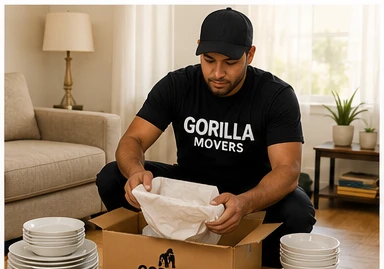
We pack
Our crew brings the boxes and materials and packs it all up. You never have to pack a single box.
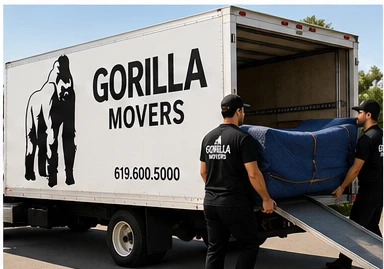
We move
We load the truck, carry everything, and do the driving. No lifting and no stairs for you.
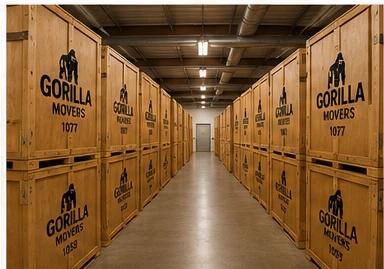
We store
If your new place is not ready yet, your things stay safe in clean, labeled storage.
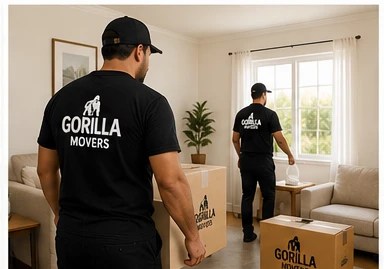
We return
When you are ready, we bring it all back and set the boxes in the right rooms.
The packing supplies you will need.
Our crew brings all of this on packing day, so you do not have to buy a thing. If you like to pack a few boxes ahead of time, here is the toolkit that makes it easy.
- Sturdy boxes in small, medium, and large
- Dish-pack boxes for kitchenware
- Wardrobe boxes for hanging clothes
- Picture and mirror boxes for framed art
- Clean packing paper (never newspaper)
- Bubble wrap for the most delicate pieces
- Packing tape and a tape gun
- A marker for labeling
- Furniture pads and stretch wrap
- Mattress bags

The right box makes all the difference.
Matching the box to what is going inside keeps everything safe and every box easy to lift. Here is the quick rule for each one.
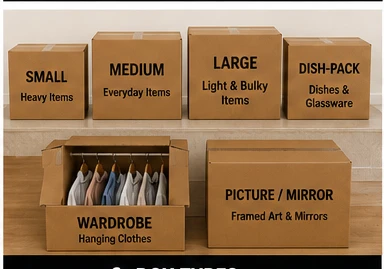
Small box
For heavy things: books, records, canned goods, and tools. Small keeps it liftable.
Medium box
The everyday workhorse: kitchen items, toys, small appliances, and decor.
Large box
For light and bulky things: pillows, blankets, linens, and lampshades.
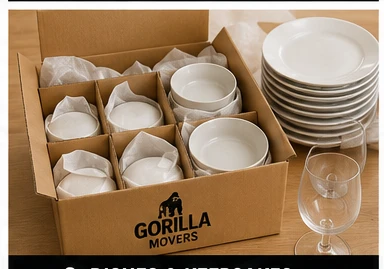
Dish-pack box
Extra-thick walls made for dishes, glasses, and stemware.
Wardrobe box
A built-in bar so hanging clothes travel upright and wrinkle-free.
Picture & mirror box
Adjusts to fit framed art, mirrors, and glass tabletops.
How to pack each room.
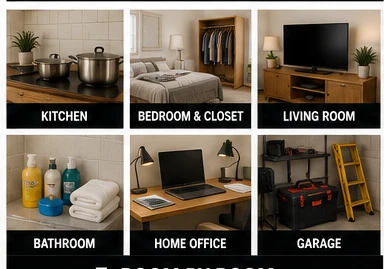
Kitchen
Wrap each dish in paper and stand plates on their edge in a dish-pack box. Tape the lids on any liquids, and empty and wipe out the fridge. Keep a few everyday dishes in your open-first box.
Bedroom & closet
Hanging clothes go in wardrobe boxes; folded clothes stay folded in large boxes. Light dressers can often move with soft items still in the drawers.
Living room
Pad the TV and coffee table, pack books spine-down in small boxes, and use a picture box for framed art. Keep remotes and cords in a labeled bag.
Bathroom
Seal anything that can leak inside a bag before it goes in a box. Toss expired medicine. Your daily toiletries go in the open-first box.
Home office
Files stand upright in a small box. Snap a photo of your cable setup before you unplug, keep chargers with their devices, and back up what matters.
Garage
Tools go in small boxes. Drain the fuel from mowers and trimmers first. Fuels, propane, and chemicals cannot ride on the truck (see the safety list below).
How to protect the fragile things.
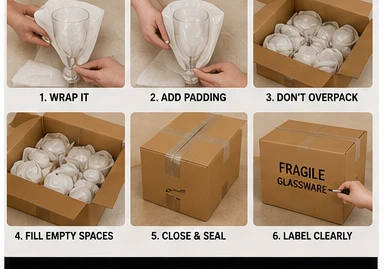
You do not have to wrap a thing yourself, but here is exactly how your china and keepsakes are cared for, step by step.
- 1
Each piece gets its own wrap
Every plate, cup, glass, and bowl is wrapped by itself in clean paper so nothing touches.
- 2
We cover the whole thing
The paper goes all the way around, over the edges, corners, handles, and rims. Those chip first.
- 3
A cushioned bottom
A thick layer of crumpled paper lines the bottom of the box to soften every bump on the road.
- 4
Plates ride standing up
Plates stand on their edge, like records. That keeps the weight off their flat centers.
- 5
No empty space
We tuck paper into any gap so nothing can shift or rattle on the drive.
- 6
Sealed and labeled
The box is taped, marked FRAGILE, and noted by room so it is handled and set down with care.
Hanging clothes stay on their hangers.
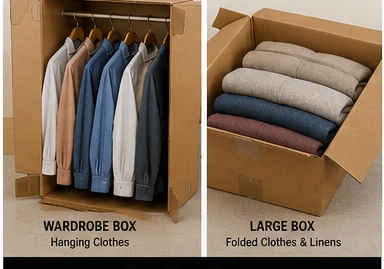
Hanging clothes
Clothes on the closet rod go straight into a wardrobe box, which has its own bar to hang them on. Shirts, dresses, jackets, and coats ride upright, still on their hangers. Our crew moves them from the closet for you.
Folded clothes and linens
Folded clothing, towels, sheets, and blankets go into large, light boxes. Keep a few days of clothing in your essentials bag instead of packing all of it, and we will keep the boxes light and easy to place.
Clear labels make unpacking simple.
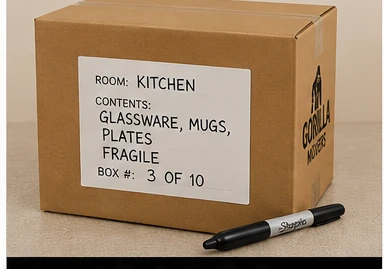
Every box gets a clear label so the crew can set it in the right room at your new place. Please leave our labels on. They keep your things together from the first box to the last.
- Room: Kitchen, Bedroom, Bathroom, Living Room
- Contents: a few plain words, like “Dishes and Mugs”
- FRAGILE, marked when the box holds breakables
- A box number, so nothing goes missing
A few tricks our crew swears by.
Small habits that keep boxes safe, liftable, and easy to unpack.
Heavy things, small boxes
Books, dishes, and canned goods go in small boxes. Light, bulky things like pillows and bedding go in big ones. Every box stays easy to lift.
Fill each box to the top
A full box stays firm when others are stacked on it. Tuck paper or a towel into any empty space so nothing shifts.
Do not overpack a box
If a box is hard to lift, it is too heavy. About the weight of a full grocery bag is plenty.
Tape the bottom well
Run tape down the center seam and along both edges of the bottom. A few seconds there saves a spilled box later.
Label the side, not the top
Write the room and the contents on the side, so you can read it once boxes are stacked. Mark FRAGILE where it belongs.
Keep the small parts together
Screws, bolts, and remotes go in a labeled bag, taped to the furniture they belong to.
The mistakes worth skipping.
These are the slip-ups we see most. Avoid them and packing day goes smoothly.
- Do not mix rooms in one box. One room per box makes unpacking simple.
- Do not overpack. A box you cannot lift easily is too heavy and more likely to break.
- Do not use grocery bags or weak, used boxes. They tear and crush under weight.
- Do not leave empty space. Loose items shift and break, so fill the gaps with paper.
- Do not wrap in newspaper. The ink rubs off on your things. Use clean packing paper.
- Do not stack heavy boxes on fragile ones. Pack breakables last, on top, marked FRAGILE.
- Do not pack valuables, medications, or documents in the truck. Those ride with you.
- Do not pack anything hazardous. Fuels, aerosols, and chemicals are not allowed.
- Do not leave it all for the last day. A little each day beats one exhausting push.
Pack one bag to keep with you.
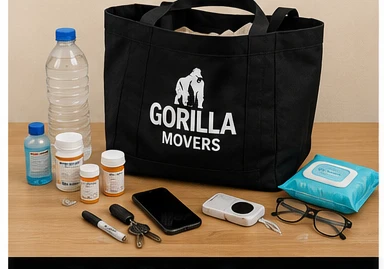
Before our crew starts, set aside one bag or small suitcase for the things you might need right away. This bag rides with you, never in the truck and never in storage.
- Your medications, enough for a few weeks
- A current list of your medications and doses
- Photo ID, Medicare, and insurance cards
- Eyeglasses, hearing aids, and spare batteries
- Cell phone and charger
- Any cane or walker you use every day
- A few days of clothing and your toiletries
- Cash, checkbook, and important phone numbers
- Something that feels like home: a photo or small keepsake
What cannot go in the truck or storage.
A few things should not be packed, for safety, and a few should simply stay with you. When you are not sure, leave the item out and point it out to the crew.
Please do not pack
- Gasoline, propane, lighter fluid, or any fuel
- Paint, solvents, or flammable liquids
- Aerosol cans and cleaning chemicals
- Fireworks, ammunition, or explosives
- Open or leaking liquids
- Food that can spoil, or anything already opened
Keep with you
- Medications and medical devices
- Cash, your checkbook, and jewelry
- ID, passport, Medicare, and insurance cards
- Wills, deeds, and legal or financial papers
- Irreplaceable family photos and heirlooms
- Anything you might need on short notice
Downsizing, at your own pace.
A lot of moves later in life also mean moving to a smaller place. Sorting a lifetime of things is the hard part, and it is emotional, not just physical. Take your time. There is no prize for rushing.
One room at a time
Start with the easiest room and finish it before you move on. Small wins keep it from feeling like too much.
Measure the new place
Get the room and closet sizes first. When you keep only what fits, the new home feels calm from day one.
Keep, gift, donate, let go
Four simple piles. Passing treasured pieces to family now, while you can see them enjoyed, is one of the best parts.
Take a photo of it
For the things you cannot bring, a picture keeps the memory without keeping the box. The story still comes with you.
Lean on family
Adult kids can label boxes, run donations, and make the calls. Share the load. It is a lot for one person.
We pack the rest
Once you decide what comes along, our crew boxes all of it. You decide, we do the work.
A few gentle steps to get ready.
Keep walkways clear
Move loose rugs, cords, and clutter out of the hallways so no one trips while we work.
Point out what stays
If an item needs to stay with you, just tell the crew before we begin.
Set your essentials bag aside
Keep it in a spot the crew will not touch.
Settle pets in a quiet room
A calm space away from the doors keeps them safe and relaxed.
Leave the heavy things to us
Boxes and furniture are our job, every time. Please do not lift.
When in doubt, ask
Leave the item where it is and a crew member will help you decide.
From packing day to coming home.
Packing day
Our crew arrives, protects your floors and doorways, and packs the whole place. We wrap the fragile things and label every box by room.
Move-out day
We load the boxes and furniture and carry it all out. You keep your essentials bag with you and let us do the lifting.
Storage, if you need it
If your new home is not ready, your things wait in clean, labeled storage. Nothing gets lost or mixed up.
Coming home
Once your place is ready, we bring everything back and set each box in the room on its label, so unpacking is easy.
Questions we hear the most.
Do I have to pack anything myself?
How far ahead should I book?
Where do I get boxes and packing materials?
How many boxes will I need?
What if my new place is not ready yet?
Can my family help coordinate the move?
Are you licensed and insured?
How much does a move cost?
Any questions? Just ask.
We have helped San Diego families through 25,120+ moves. Licensed and insured (CAL T-192729 | USDOT 3801918), and $5 from every move goes to the Dian Fossey Gorilla Fund.